Why mid-bore engines are the next growth battlefield (and why 2025 changed everything)
Think you know the mid-bore market? Think again, says Andrea Lazzaro, Head of Business Development at WinGD, who predicts a shift in market dynamics as regulatory uncertainty, changing fuel strategies and competitive dynamics prompt a rethink of what long-term value and retrofit-ready really looks like.
For years, the mid-bore engine segment was treated as the stable middle child of the marine propulsion market: large in volume, conservative in design, and largely locked into established supplier relationships. In 2025, that changed.
What was once a steady 5,000–7,000MW market in 2018 has grown into a 10,000–15,000MW annual segment, effectively doubling at its peak. That expansion alone would make mid-bore strategically important but structural shifts beneath the surface - in fuel strategy, cost pressure, and competitive dynamics - have turned it into the industry’s next growth battlefield.
A settled market, primed for a reset
Historically, this was a segment characterised by standardised ship designs, repeated series builds and tight yard-owner relationships, which taken together created what might be called a “design lock-in” effect. Yards repeat what works. Owners avoid design disruption. Switching engines implies foundation changes, piping rework, engineering risk, crew retraining and new spare parts inventories, which are all unwelcome in price-sensitive projects. If an engine was not in the original design, it was often out for a generation.
But change doesn’t have to be a negative – in fact, it’s essential to not only stay competitive but also compliant.
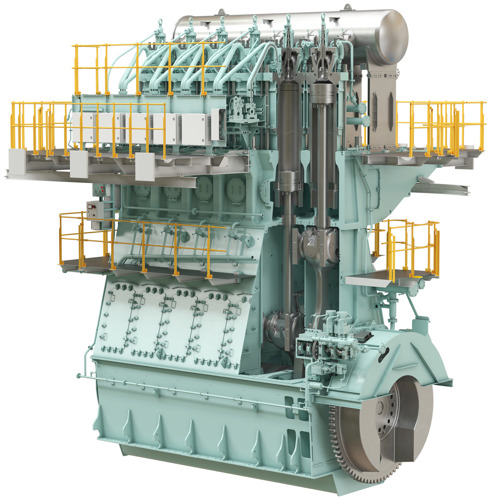
The new mid-bore paradigm: Flexibility
Compliance with decarbonisation rules weigh heavily on investment decisions. In October the IMO opted to delay by one year a vote on its net zero framework, leaving shipowners adrift without any clear direction on incentives and penalties to facilitate the transition. The business case to invest in new fuels – which are both hard to find and prohibitively expensive – became that much harder to make. As a result, across all market segments, the order book is again skewing back to the norm: traditional oil bunkers. According to one analysis, in the eight months leading into 2026, the global orderbook recorded a net increase of 9 million MToE of bunker demand, with 7.5 million MToE (83%) of that tied to traditional oil fuels1. In 2025, conventional fuels surged back to over 90% of mid-bore orders globally, reversing years of gradual transition. Owners, faced with unclear incentives, are opting for flexibility rather than commitment. This search for flexible and adaptive solutions in an uncertain world favours retrofit-ready concepts.
This creates openings for players like WinGD, with its portfolio of flexible and retrofit-ready engines. Our engines are fuel-flexible by design so shipowners can optimise performance from the heavy fuels oils they already know with the confidence that they’re prepped to switch to cleaner fuels when the time is right.
Our OEM credentials and strong inhouse service offer, including retrofit solutions, have proved compelling in conversations with shipowners in China, where our share of the mid-bore market has surged over the past year from around 4% to 20%. With more than 100 engines in the production pipeline, supplier pricing dynamics change and the argument that we build too few engines to be cost-competitive no longer holds. At least seven of these engines were ordered fully retrofit-ready, with pre-installed future fuel equipment features. The rest, like all WinGD mid-bore engines delivered as of today, are what we call ‘retrofit capable’ – the equipment is not pre-installed but there’s no need for any structural work to complete the retrofit.
Competing beyond price: value in a price-sensitive segment
Mid-bore is a price-sensitive market but price alone does not win. Owners are looking for value beyond price, such as integrated SCR which offers a plug-and-play installation and reduced engine-room footprint.
In a segment where margins are tight and delivery schedules unforgiving, installation simplicity translates directly into commercial value.
Engine changes historically trigger resistance because of cost, redesign risks and operational challenges related to spare parts inventories and crew retraining , but the compact footprint and foundation compatibility of the X52S-2.0 and of the X62S-2.0 with the competitor engines reduces switching complexity and lowers the one-time switching costs to be borne by the shipyard. And perhaps most importantly, in-house full life-cycle support from the OEM delivers the peace of mind that this critical asset will be supported to optimise vessel performance for years to come.
Looking ahead: why mid-bore defines the next cycle
Forecasts suggest a softening in large containers over the next two years, while mid-bore volumes are expected to recover and expand toward the end of the decade in all segments despite a current slow-down in bulk carrier orders, becoming more important as a fraction of the whole market. Indeed, by 2028–2030, mid-bore could represent half of total engine market volume if the expected reduction in large container orders reaches the worst-case levels forecast by Clarksons Research (September 2025) as the fleet mix shifts downwards in size, trade patterns favour flexibility and capital discipline supports mid-sized vessels.
For any engine designer seeking stable baseline market share, mid-bore is a key market. For those looking to rethink their mid-bore supplier and invest in a future-ready design with global support, now is the time to talk.